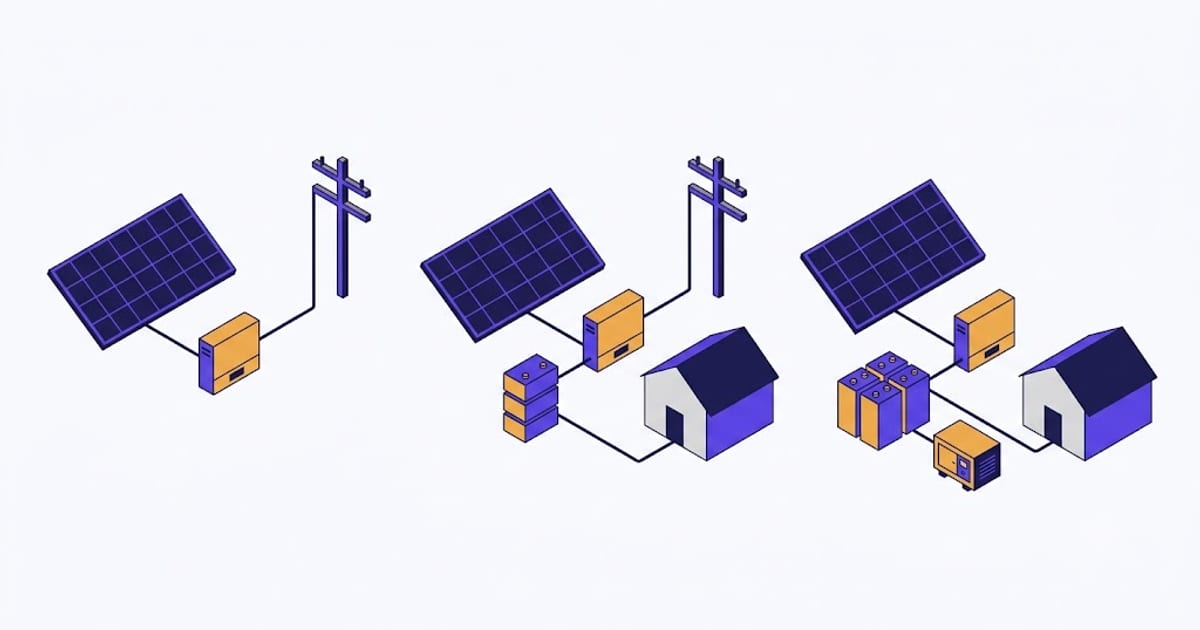
Three configurations, and the differences matter most on the day the grid fails.
Grid-tied
Panels, an inverter, and a connection to the utility. No batteries. Excess exports; shortfall imports.
Cheapest per watt, simplest, fewest components to fail, and the best return where net metering is favourable.
In a power cut it shuts down. This is deliberate and required: anti-islanding protection stops the inverter back-feeding the network while linemen are working on it. A sunny afternoon blackout with a 10 kW array on the roof produces nothing.
Hybrid
Panels, a hybrid inverter, and a battery. Still grid-connected, but able to run selected circuits when the grid is down.
Costs substantially more — the battery plus a more complex inverter plus, usually, a critical-loads subpanel. In return you get backup power, and where tariffs have peak periods you also get arbitrage: store cheap, use expensive.
Most hybrid systems back up a subset of circuits — fridge, lights, internet, a few sockets — rather than the whole house. That keeps the battery and inverter within sensible size, and it is the right design in nearly every case.
Off-grid
No utility connection. The system must cover every load in every season, with generation, storage and usually a generator.
This is not grid-tied with batteries added; it is a different design problem, because there is no backstop. Sizing is governed by the worst month and the longest cloudy run, and load reduction matters more than generation.
Choosing
| Grid-tied | Hybrid | Off-grid | |
|---|---|---|---|
| Relative cost | 1× | 1.6–2.2× | 2.5–4× |
| Works in a blackout | no | yes, selected circuits | yes |
| Battery | none | moderate | large |
| Generator | no | optional | usually required |
| Best where | good net metering, reliable grid | frequent outages, peak tariffs | no grid, or connection cost is prohibitive |
The connection cost that decides off-grid
Utilities quote extension costs per distance, and beyond a few hundred metres the figure gets large quickly. Where an extension costs more than a full off-grid system, off-grid stops being a lifestyle choice and becomes the cheaper option.
Get the utility quote in writing before designing anything. It is the single number that decides which of these three you are building.
Batteries can be added later — sometimes
If backup is a maybe, buy a hybrid-capable inverter now and add the battery later. Retrofitting a battery to a plain grid-tied string inverter usually means replacing the inverter, and that turns a later upgrade into an expensive one.
The premium for hybrid capability at purchase is far smaller than the cost of that replacement.