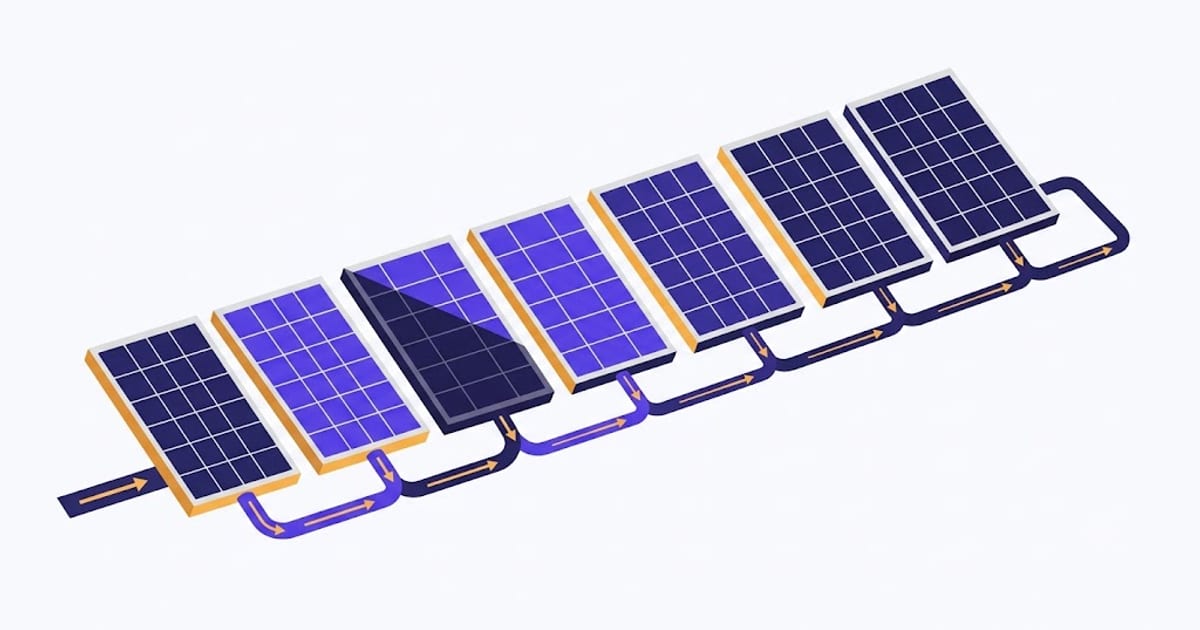
Panels in a string are wired in series, so the same current flows through every one. A shaded panel produces less current, and in series the whole string is limited to the weakest member.
That is why shading is the one loss in solar that is wildly disproportionate to its area.
Bypass diodes limit the damage
Modern panels contain three bypass diodes, each spanning about a third of the cells. When a group is shaded badly enough, its diode conducts and the current routes around it.
So a fully shaded third of one panel costs roughly a third of that panel — not the whole string. That is a large improvement over early panels, and it is why the "one leaf kills the array" story is dated.
What bypass diodes do not fix is partial shading across many cells: light shade that reduces output without triggering the diodes drags the string down without any bypass happening.
What it looks like in practice
A chimney shadow crossing the bottom row of a 20-panel string for three hours a day in winter can cost 10 to 15% of annual production, against maybe 3% of array area.
Shade patterns are worst in winter, when the sun is low and shadows are long — which is also when production is scarcest.
The fix: per-panel electronics
Optimisers — a small DC-DC converter behind each panel that lets each one operate at its own maximum power point while still feeding one central string inverter.
Microinverters — a full inverter per panel. Each panel is electrically independent.
Either recovers most of the mismatch loss. On a shaded roof they routinely pay for themselves; on an unshaded south roof they are additional cost and additional roof-mounted electronics for a very small gain.
The decision is almost purely about shade, and it deserves a site survey rather than a guess.
Survey the shade before designing
A solar pathfinder or a phone app that traces the sun path against the horizon takes twenty minutes and tells you what the roof sees in December, not just today.
The two things to look for: winter morning and afternoon shade from anything on the south side, and growth. A tree that clears the array today may not in eight years, and a system is a 25-year asset.
String layout can help
Where shade is unavoidable and per-panel electronics are not in budget, group the panels that get shaded together into their own string, separate from the clean ones. The shaded string underperforms; the clean string does not.
That costs nothing but planning, and it is often skipped.
Soiling is not shading, but it acts like it
Uniform dust costs a few percent and washes off with rain. Localised soiling — bird droppings, a leaf stuck at the bottom edge, lichen at the frame — behaves like hard shading and triggers the same mismatch. It is worth a look twice a year, particularly at shallow tilts where nothing runs off.