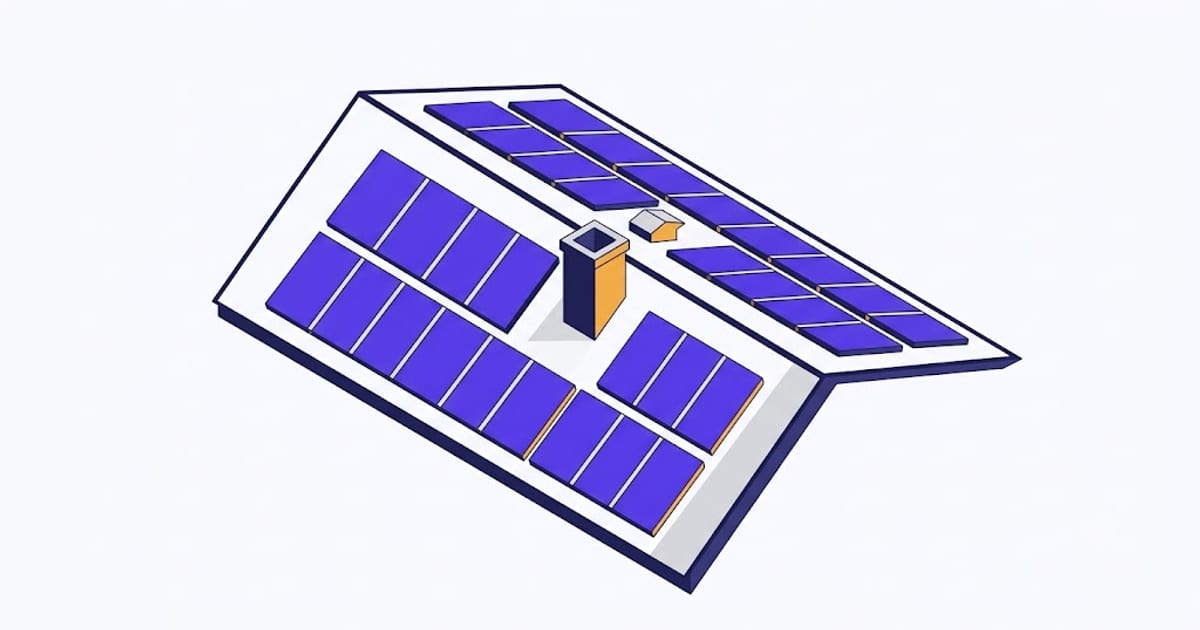
Start with twelve months of electricity bills, not with roof area. Annual kWh is the only input that describes your house rather than an average one.
The calculation
array kW = annual kWh ÷ 365 ÷ peak sun hours ÷ 0.77
A house using 10,800 kWh a year at 4.5 peak sun hours:
10,800 ÷ 365 ÷ 4.5 ÷ 0.77 = 8.5 kW
At 400 W per panel, that is 22 panels.
The 0.77 is not optional
It is the PVWatts default derate from NREL and it bundles the losses that always occur:
- Soiling ~2%
- Shading ~3%
- Panel mismatch ~2%
- Wiring ~2%
- Connections ~0.5%
- Nameplate tolerance ~1%
- Temperature ~10 to 15% in a hot climate
- Inverter efficiency ~3%
- Availability ~3%
Temperature is the largest and the least intuitive. Panels are rated at 25 °C cell temperature; a panel in full sun runs 25 to 30 degrees above ambient, and output falls about 0.4% per degree. A 400 W panel on a hot roof in July is a 330 W panel.
Skip the derate and the system will be about a quarter short — and it will look fine in April and disappoint every summer afternoon and every winter.
Roof area
22 panels at roughly 21 ft² each is 460 ft² of panel. Usable roof needs 15 to 25% more than that for row spacing, fire setbacks and obstructions — so about 550 to 580 ft² of clear, well-oriented roof plane.
Fire setback requirements vary and can be severe: many jurisdictions require a 3 ft clear path at the ridge and along at least one side.
Is 100% offset the right target?
Not always.
Net metering rules decide it. Where excess kWh are credited at retail rate, offsetting 100% makes sense. Where the export rate is well below retail — increasingly common — an array sized to your daytime consumption rather than your annual total often has a better return, because every exported kWh is worth less than every self-consumed one.
Future load matters. An electric vehicle adds 3,000 to 4,000 kWh a year. A heat pump replacing gas heating adds more. Sizing today's array to today's bill and adding panels later costs more than building for the known plan now, because the labour and the inverter are already there.
Some utilities cap system size by historical consumption. Check before designing.
Then check the seasons
The annual figure hides a swing. Production in December across most of the US is 40 to 60% of the annual average. Grid-tied, the grid covers it. Off-grid, that swing is what sizes the whole system, and the battery calculator is where that gets resolved.