Two rules size a conductor in a solar system, and you apply both and take the larger result.
Ampacity — the cable must carry the current without overheating. NEC Table 310.16, derated for temperature and for conduit fill.
Voltage drop — the cable must not lose too much of what it carries. Not a safety requirement, an economic one.
On short high-voltage runs ampacity governs. On the long low-voltage DC runs typical of off-grid systems, voltage drop governs by a wide margin, and sizing on ampacity alone is how people lose 8% of their array in a cable.
Why low voltage is punishing
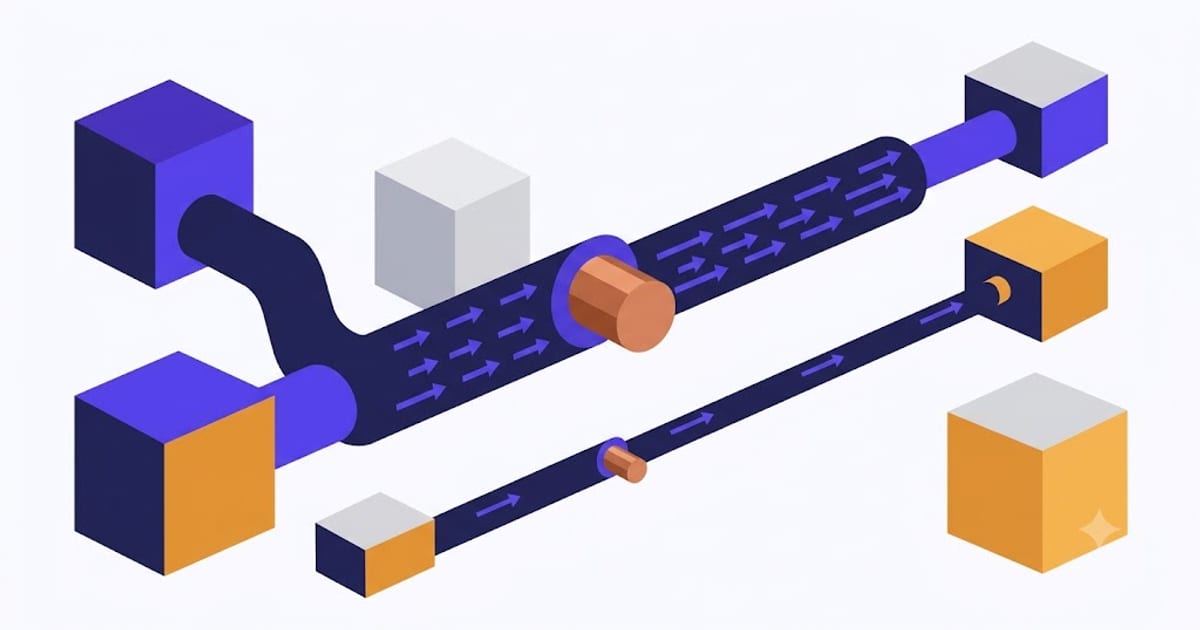
Power lost in a cable is I²R. Halve the voltage for the same power and you double the current — and quadruple the loss.
A 1,000 W run at 12 V carries 83 A. The same 1,000 W at 48 V carries 21 A. The 12 V run needs roughly sixteen times the copper for the same percentage drop.
This is the entire reason modern off-grid systems are built at 48 V rather than 12, and why grid-tied strings run at hundreds of volts.
The calculation
VD = 2 × L × I × R ÷ 1000
where L is one-way length in feet, I is current in amps, and R is ohms per 1,000 ft from NEC Chapter 9, Table 8. The factor of 2 is the return path — people forget it and get exactly half the real answer.
Copper resistance per 1,000 ft: 14 AWG 3.14 Ω · 12 AWG 1.98 · 10 AWG 1.24 · 8 AWG 0.778 · 6 AWG 0.491 · 4 AWG 0.308 · 2 AWG 0.194 · 1/0 0.122.
Targets
- 2% for the array-to-controller run and the battery-to-inverter run
- 3% total across the whole DC path
- Battery-to-inverter is the worst case: the highest current in the system, usually the shortest run, and the one where a small drop causes low-voltage cutouts under surge.
The 125% rule
NEC treats solar output as continuous — three hours or more — so conductors and overcurrent devices are sized at 125% of the current. For PV source circuits it compounds: 125% of short-circuit current for irradiance, then 125% again for continuous duty, giving 156% of Isc.
That is not conservatism stacked on conservatism; it is two different phenomena, and it is what the code requires.
Temperature derating
Conductor ampacity drops with ambient temperature, and a conduit on a hot roof runs far above air temperature — the NEC rooftop adder can be 20 °C or more. A cable that is comfortable at 30 °C ambient may be undersized at 60 °C in a conduit above dark shingles.
Aluminium
Cheaper per amp and about 60% of copper's conductivity, so it needs roughly two sizes larger for the same drop. It is common in larger service runs and it needs the right terminations and antioxidant compound. For array wiring at typical residential scale, copper is simpler.