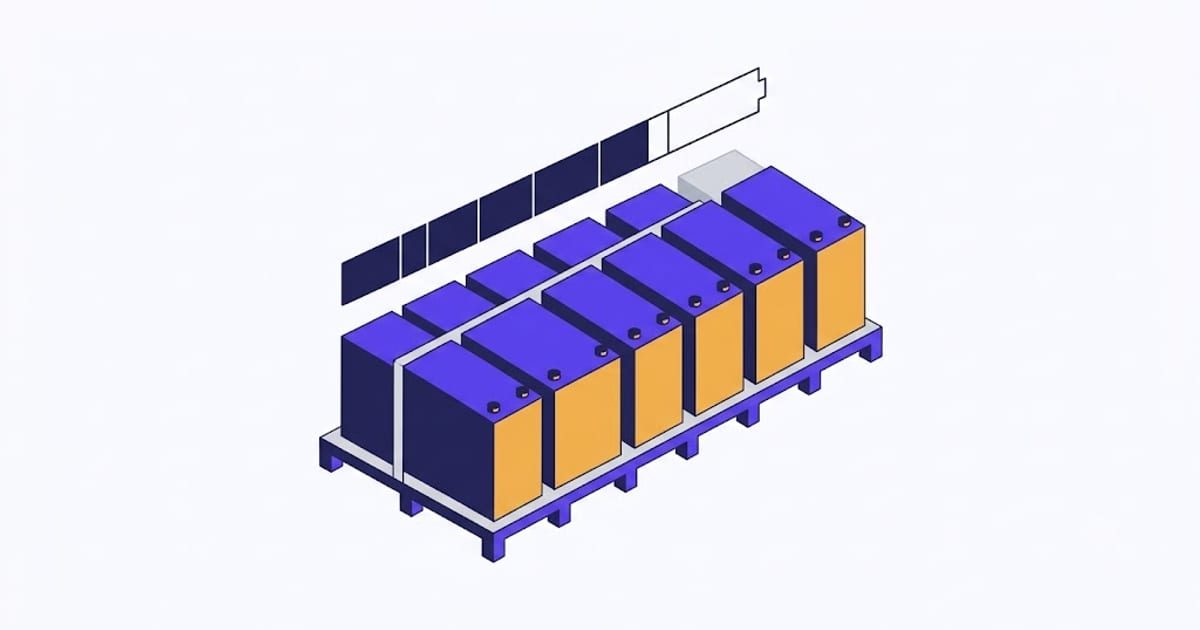
Array size answers "how much do I make". Battery size answers a different question entirely: how long can I run when I make nothing?
The calculation
bank kWh = daily load kWh × days of autonomy ÷ depth of discharge ÷ system efficiency
A house using 8 kWh/day, wanting 2 days of autonomy, on lithium at 80% usable and 90% round-trip:
8 × 2 ÷ 0.80 ÷ 0.90 = 22.2 kWh
The same requirement on flooded lead-acid at 50% depth of discharge and 80% efficiency:
8 × 2 ÷ 0.50 ÷ 0.80 = 40 kWh
Nearly double, for the same job. Nameplate capacity is not comparable across chemistries, and comparing prices per nameplate kWh is comparing the wrong number.
Depth of discharge is a lifespan setting
| Chemistry | Usable DoD | Typical cycles at that DoD |
|---|---|---|
| Flooded lead-acid | 50% | 1,000–1,500 |
| AGM | 50% | 500–1,000 |
| LiFePO₄ | 80–90% | 3,000–6,000 |
Lead-acid discharged to 80% regularly will not last a fraction of its rated life. The 50% figure is not conservatism, it is the condition its cycle rating assumes.
Lithium tolerates deep cycling and is happiest not sitting at 100% state of charge for long periods, which is the opposite of lead-acid's preference.
Days of autonomy, realistically
1 day — grid-tied with backup, or a system with a generator on hand. 2 days — the usual off-grid figure with a generator as backstop. 3–5 days — off-grid with no generator, in a climate with real cloudy spells.
Each extra day is expensive, and past about three the economics usually favour a generator instead. A generator costs a fraction of the equivalent battery and only burns fuel on the days it runs.
Winter is what actually sizes it
Off-grid systems fail in January, not in July. Production across most of the US in December is 40 to 60% of the annual average, and cloudy stretches cluster.
Size the array for the worst month and the bank for the longest cloudy run in that month — not for the annual average, which is a summer-weighted number.
Temperature
Lead-acid loses about 20% of capacity at 0 °C and lithium should not be charged below freezing at all without a heater or a low-temperature cutoff. An unheated shed in a northern climate is not a battery location without allowing for both.
Work the bank size from your own load and autonomy on the battery calculator, and check it against the array sizing for the same winter month — the two have to agree or the system runs down.