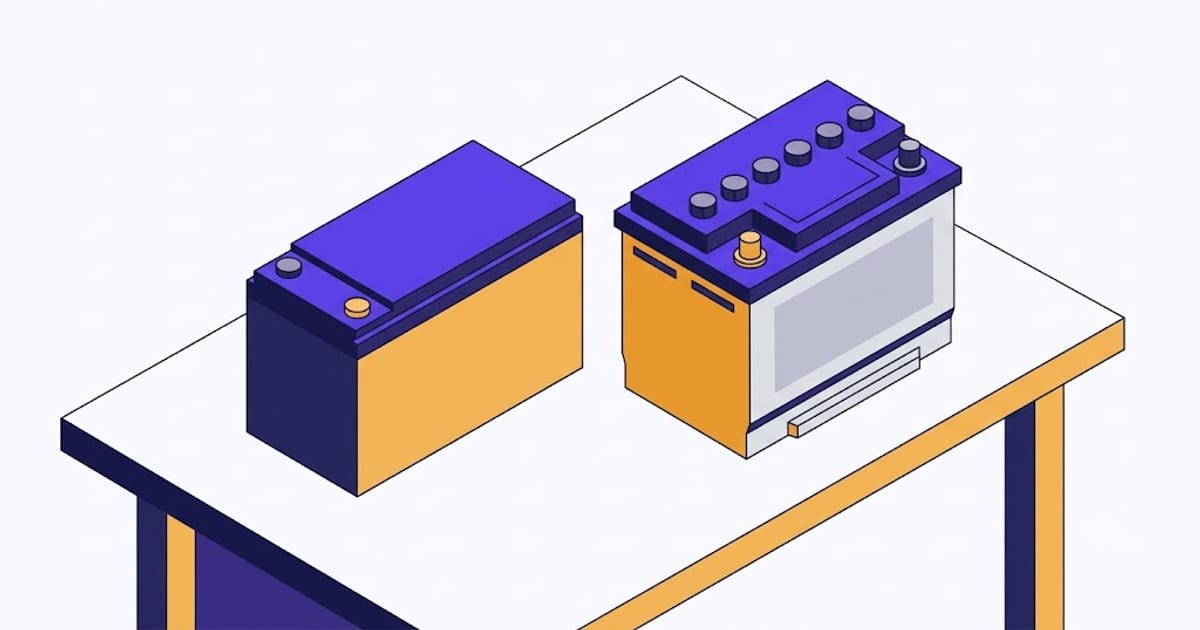
On the shelf, lead-acid wins on price per nameplate kilowatt-hour, often by a factor of two or three.
Delivered over a system's life, it loses, usually by a wide margin. Two properties account for nearly all of it.
Usable capacity
Lead-acid should not be discharged past about 50% of nameplate. Go deeper routinely and cycle life collapses.
LiFePO4 tolerates 80–100%.
So a 10 kWh lead-acid bank gives you 5 kWh. A 10 kWh LiFePO4 bank gives you 8 to 10. Before considering anything else, you need roughly twice the lead-acid to do the same job — which halves the apparent price advantage immediately.
Cycle life
| Cycles | At DoD | |
|---|---|---|
| Flooded lead-acid | 500–1,200 | 50% |
| AGM | 600–1,500 | 50% |
| LiFePO4 | 3,000–6,000 | 80% |
A cycle is one discharge and recharge. In daily solar use, that is roughly one cycle a day.
At one cycle a day, 1,000 cycles is under three years. Four thousand cycles is over ten. Lead-acid gets replaced two or three times inside a single lithium bank's life, and each replacement is the full purchase again plus the labor.
Cost per delivered kilowatt-hour
Combining the two:
Lead-acid: 10 kWh nameplate × 50% usable × 1,000 cycles = 5,000 kWh delivered over its life. LiFePO4: 10 kWh nameplate × 90% usable × 4,000 cycles = 36,000 kWh delivered.
Seven times the energy from the same nameplate. Even at three times the purchase price, lithium is delivering energy at roughly half the cost — and that is before counting the replacements avoided.
Run this with your own quoted prices rather than these round numbers. The arithmetic is nameplate × DoD × cycles, and it is the only comparison that means anything.
The other differences
Charging efficiency. LiFePO4 returns about 95–99% of what goes in; lead-acid around 80–85%. On a solar system that is a permanent tax on every kilowatt-hour the array produces — you are buying panels to feed the losses.
Charge acceptance. Lead-acid charges slowly as it approaches full, spending hours in an absorption stage. On short winter days a bank may never reach full, and chronic undercharging is what kills lead-acid banks early. Lithium accepts high current almost to the top.
Weight. LiFePO4 is roughly a third the weight for the same usable energy. Decisive in an RV or boat, irrelevant bolted to a garage wall.
Maintenance. Flooded lead-acid needs topping up with distilled water and needs ventilation for the hydrogen it produces. AGM and lithium are sealed.
Cold. This is lithium's real weakness. LiFePO4 must not be charged below freezing without a heater — discharge is fine, charging is not. Many quality units include heating; cheap ones do not, and in an unheated space that omission destroys the pack. Lead-acid charges cold without complaint, though capacity drops.
Where lead-acid still makes sense
Not never:
- Rarely cycled backup. A bank that sits full and discharges a few times a year never reaches its cycle limit, so lithium's main advantage does not apply.
- Genuinely tight upfront budget. If the choice is a small lead-acid bank now or nothing, the bank now is worth more.
- Sub-freezing unheated installations without a heated lithium option.
- Very large, cost-driven stationary banks where space and weight are free.
For everything cycled daily — which is nearly all solar storage — LiFePO4 is the cheaper battery. It just does not look that way on the invoice.
Sizing either one is covered in how many batteries for a 10 kW system.
FAQ
Is LiFePO4 worth the extra cost over lead-acid?
For daily-cycled solar storage, yes. It delivers several times more energy over its life from the same nameplate capacity, which more than covers a two- to three-times higher purchase price.
How deep can you discharge a lead-acid battery?
About 50% of nameplate. Deeper discharges shorten cycle life sharply.
How long does a LiFePO4 solar battery last?
Typically 3,000–6,000 cycles at 80% depth of discharge — ten years or more at one cycle a day.
Can LiFePO4 batteries be used in cold weather?
They discharge fine in the cold but must not be charged below freezing without an internal heater. Check whether the unit has one before installing anywhere unheated.
Do lithium batteries need maintenance?
No watering or ventilation, unlike flooded lead-acid. The battery management system handles cell balancing internally.