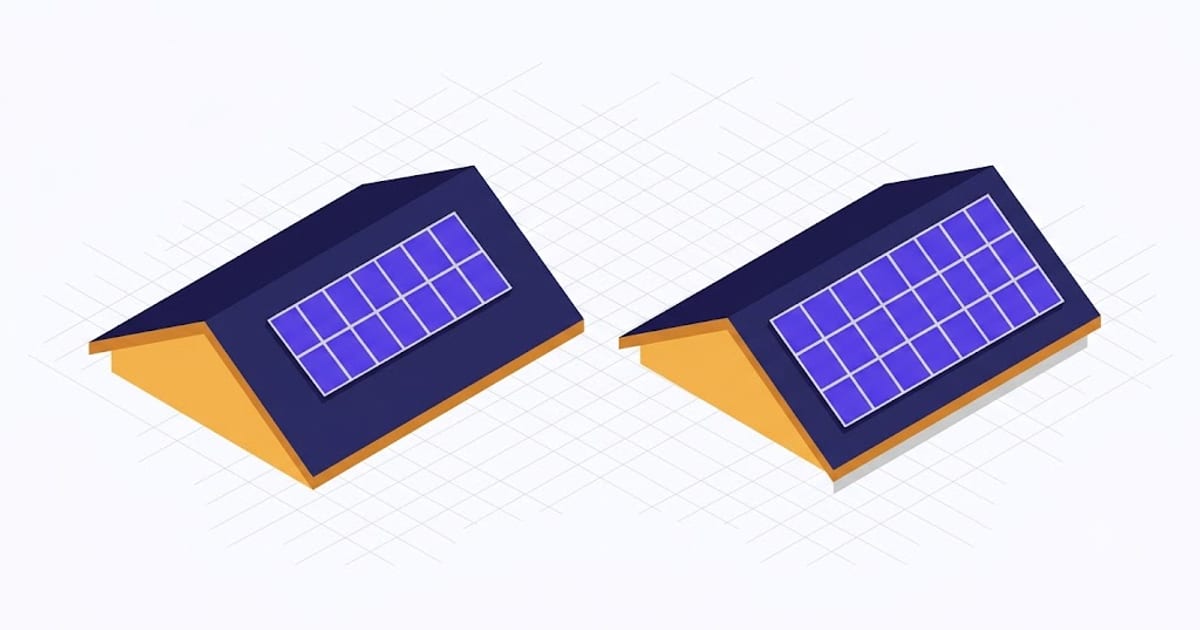
A thousand kilowatt-hours a month is close to the US household average, which is why it is the number people search. The answer is not a number — it is a range from about fifteen panels to about thirty-four, for the same consumption.
The formula behind all of it is in sizing a home solar array.
The two things that move the answer
Where you are. Peak sun hours range from roughly 3.5 in the Pacific Northwest and interior New England to about 5.5 in the desert Southwest. That single factor changes the system size by more than half.
What panel you buy. Residential panels commonly run 350 W to 500 W. A higher-wattage panel means fewer panels and less roof, for the same system size.
The table
For 12,000 kWh a year at a derate factor of 0.80:
| Sun hours | System | 350 W | 400 W | 450 W | 500 W |
|---|---|---|---|---|---|
| 3.5 | 11.7 kW | 34 | 29 | 26 | 23 |
| 4.5 | 9.1 kW | 26 | 23 | 20 | 18 |
| 5.5 | 7.5 kW | 21 | 19 | 17 | 15 |
Fifteen panels in Phoenix, thirty-four in Seattle. Both cover 1,000 kWh a month. Any single national "how many panels" figure is averaging across that spread and telling you about nobody's house.
Roof area
Panels are roughly 18 to 24 square feet each depending on wattage — higher-output panels are usually physically larger, so the roof area for a given system size is more stable than the panel count suggests.
| System | Panel area | Realistic roof needed |
|---|---|---|
| 7.5 kW | ~390 sq ft | ~510 sq ft |
| 9.1 kW | ~480 sq ft | ~620 sq ft |
| 11.7 kW | ~615 sq ft | ~800 sq ft |
The right-hand column adds about 30 % for the things that are not panel: fire access pathways and setbacks required by code, spacing between rows, clearance around vents, plumbing stacks and chimneys, and the fact that roof planes are rarely the shape your array wants to be.
Only usable roof counts. South-facing is best in the northern hemisphere; east and west work at reduced output; north-facing is generally not worth it. A house with a large roof mostly facing the wrong way has less usable area than the square footage suggests.
Sanity-check your own consumption first
Before any of the above, get your real annual figure off twelve months of bills. Reasons the average is a bad substitute:
- Electric heat shifts consumption enormously toward winter, which is exactly when solar production is lowest.
- An EV can add 3,000–5,000 kWh a year on its own, and that is a large fraction of a typical array.
- Air conditioning loads the summer, which aligns well with production — a house whose consumption peaks in July is a better solar match than one that peaks in January.
Two houses both using 12,000 kWh a year, one heated by gas with summer air conditioning and one heated by electricity, are not the same solar project even though the annual number matches.
Should you cover 100 %?
Sizing to your annual consumption assumes you get fair credit for the electricity you export. That depends entirely on your utility:
- Full retail net metering — exporting is worth as much as consuming, so sizing to 100 % of annual use makes sense.
- Net billing at a lower export rate — exported units are worth less than imported ones, so the optimum is a smaller array shaped around your daytime load.
- No export credit — the optimum is smaller still, or paired with a battery.
This is the single largest variable in whether the project makes financial sense, and it is a local regulatory question rather than an engineering one. Find out before sizing.
What the panel count does not tell you
- Inverter capacity is sized separately, usually somewhat below the array's DC rating.
- Shading is a design problem rather than a percentage. A chimney or a tree can dictate microinverters or optimisers regardless of panel count.
- Structural capacity. The roof has to carry the array plus wind and snow load, and older roofs sometimes need work.
- Roof age. Putting an array on a roof with a few years left means paying to remove and refit it.
What this page does not cover
- The derate factor and what it is made of are on the main sizing page.
- Batteries, which answer a different question and are sized from your backup load rather than your consumption.
- Incentives and tax credits, which vary by jurisdiction and change often.
- Site-specific modelling. Tools that model hourly weather for your actual coordinates will beat this arithmetic for a final design.
Fifteen to thirty-four panels. Find your sun hours before anyone quotes you a number.